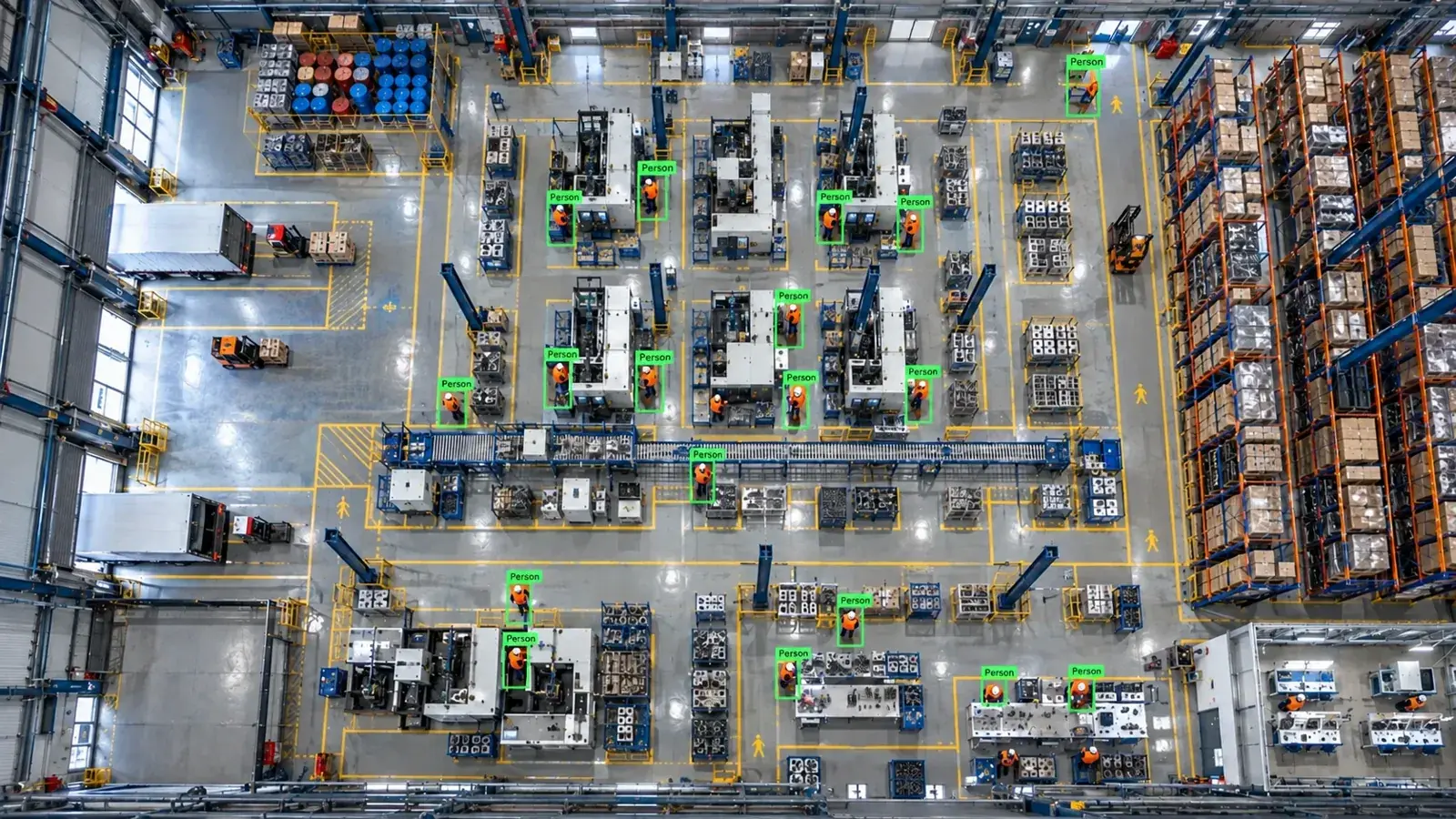
Frequently asked questionsAbout cameras, deployment, data privacy and modules.
What is the difference between machine vision and computer vision?
Machine vision traditionally refers to rule-based inspection systems with dedicated industrial cameras and controlled lighting. Computer vision is the broader field; in industry today it usually means deep-learning models that also work on general CCTV footage and in variable conditions.
Do we need GPUs on site?
For on-premise processing, an edge device with suitable acceleration is used. The hardware is sized to the number of cameras and analytics during discovery.
How long does a pilot take?
It depends on the use case and number of cameras. Ready-made safety analytics can be deployed quickly; custom quality inspection models need time for data collection and validation.
Can Hype Vision work with existing CCTV cameras?
In most projects, yes. Cameras or NVRs that provide RTSP or ONVIF streams can be connected regardless of brand. Each camera’s view is checked for suitability before a pilot.
Do we need to replace our cameras?
Usually not for safety and operations use cases. Some views may need repositioning or an additional camera. Visual quality inspection often needs dedicated cameras and lighting.
Can the system run on-premise?
Yes. Analysis can run on edge hardware inside your network so that video is processed locally.
Can it operate without sending video to the cloud?
Yes. In an on-premise deployment, video stays on-site; only event data and, if enabled, short evidence clips are stored for review.
Can PPE detection work with our current CCTV cameras?
In most cases, yes. If the cameras provide an RTSP/ONVIF stream and the area is visible at a usable size, they can be analysed. Camera suitability is checked on sample footage before committing to a pilot.
Does the video leave our site?
Not in an on-premise/edge deployment. Analysis runs on hardware inside your network and only event data (and evidence clips, if enabled) is stored.
How is detection accuracy validated?
During the pilot, events are reviewed against labelled footage from your own cameras. True detections, false alarms and missed events are counted per camera so results reflect your site, not a lab dataset.
Do forklifts need tags or sensors?
No. Detection is camera-based, so vehicles and people do not need wearables or tags.
Can an alert trigger a local warning light?
Yes, events can drive relay outputs for beacons or sirens near the crossing. The exact wiring is defined with your maintenance team.
Will it slow down operations with false alarms?
Zone and duration rules are tuned during the pilot and false alarms are measured per camera. Rules are only rolled out once the alarm rate is acceptable to the operations team.
Can different rules apply at different times?
Yes. Zones can have schedules, for example allowing access during maintenance windows and alerting outside them.
Can it tell authorised staff apart from others?
Not by face. Where needed, events can be combined with access-control data or PPE/uniform rules defined for the site.
Does fall detection require wearables?
No. It uses existing camera views; no device needs to be worn.
How quickly is an alert sent?
With on-premise processing, alerts are generated shortly after the confirmation window. The exact latency depends on the network and notification channel and is measured during the pilot.
Can this replace our smoke detectors?
No. It is an additional early-warning layer for areas that cameras already cover. Certified fire detection systems remain required.
How are false alarms from steam or lights handled?
A temporal confirmation step and per-camera tuning are used. False alarm rates are measured on your footage during the pilot.
Can you calculate OEE from cameras?
Cameras can provide running time, counts and cycle times, which cover availability and performance. Quality usually comes from inspection results or existing systems and can be combined via integration.
Do we need to connect to our PLCs?
No, but it is possible. Camera-based measurement works without PLC access, which is useful for older equipment.
Can it count different product types separately?
If the product types are visually distinguishable, a model can be trained to classify them. Feasibility is assessed on sample footage.
How is counting accuracy checked?
Camera counts are compared to manual or system counts over defined periods in the pilot, and the difference is reported per camera.
How many defect images do we need?
It depends on the defect type and variation. Common defects may need hundreds of examples; for rare defects, anomaly detection trained on good parts is often used.
Can it keep up with our line speed?
Line speed is measured during discovery and camera, triggering and edge hardware are chosen accordingly.
Is this individual employee monitoring?
The recommended setup reports at station and process level. Individual-level use must be assessed with your legal and HR teams and local regulations such as GDPR or KVKK.
What do supervisors see?
Station-level dashboards: occupancy, active and idle time, and bottlenecks per shift.
Can it alert staff to open another counter?
Yes, threshold-based alerts can be sent to managers or displayed on a dashboard.
Does it recognise customers?
No. It counts people in an area; it does not identify them.
Can we use our security cameras for counting?
Often yes, if the camera covers the entrance at a usable angle. If not, repositioning or adding a camera at the door is recommended.
Does it store personal data?
Counting does not require identifying anyone. Retention of video and event data is configured with your data-protection requirements.
Can occupancy be combined across several cameras?
Yes, zones from multiple cameras can be aggregated, provided overlapping views are configured to avoid double counting.
Can it read licence plates?
Licence plate recognition is a separate capability and is evaluated per project; contact us with your requirement.
How is this different from defect detection?
Defect detection recognises known defect types. Anomaly detection flags anything that differs from normal, which helps with rare or new problems but needs review.
Do we need to change our VMS or NVR?
No. The analytics layer reads streams in parallel; recording continues as before.
Will analytics slow down our recording system?
Analytics usually reads a separate stream. The load on cameras and NVRs is reviewed during camera assessment.
Can analog cameras be used?
Analog cameras need an encoder or DVR that provides an IP stream. Image quality from older analog cameras often limits what can be detected.
Which use case should a plant start with?
The one with a clear owner and measurable impact — often PPE or danger-zone compliance for HSE, or downtime visibility for production. The discovery call is used to choose.
Can one system serve HSE, production and quality?
Yes. The same cameras and edge hardware can run several analytics, with separate dashboards and alerts for each team.
Do vehicles or people need tags?
No. Detection is purely camera-based.
Does it identify customers?
No. It counts and measures movement anonymously.
Can rules differ between kitchen and dining areas?
Yes. Each zone has its own rules and alert recipients.
Can occupancy be shown on screens for guests?
Occupancy figures can be exposed via API to digital signage; this is configured per project.
Can it work on sites without fixed network infrastructure?
It depends on camera connectivity on site. Edge processing reduces bandwidth needs; connectivity is assessed during discovery.
Can small pieces be counted with existing cameras?
Only if they are visible at sufficient size. Close-up cameras at transfer points are often needed; this is checked during camera assessment.