
AI and Camera Solutions for Label Inspection in Food PackagingEnsure accurate label inspection on food packaging with AI-powered camera systems. Discover Hype Vision's turnkey automatic label control solution.
Correct and complete labeling on food packaging is critical for legal compliance and consumer trust. Traditional methods relying on the human eye struggle with rising production speeds and error risks. Hype Vision offers an AI-driven label inspection solution that easily integrates with existing cameras.
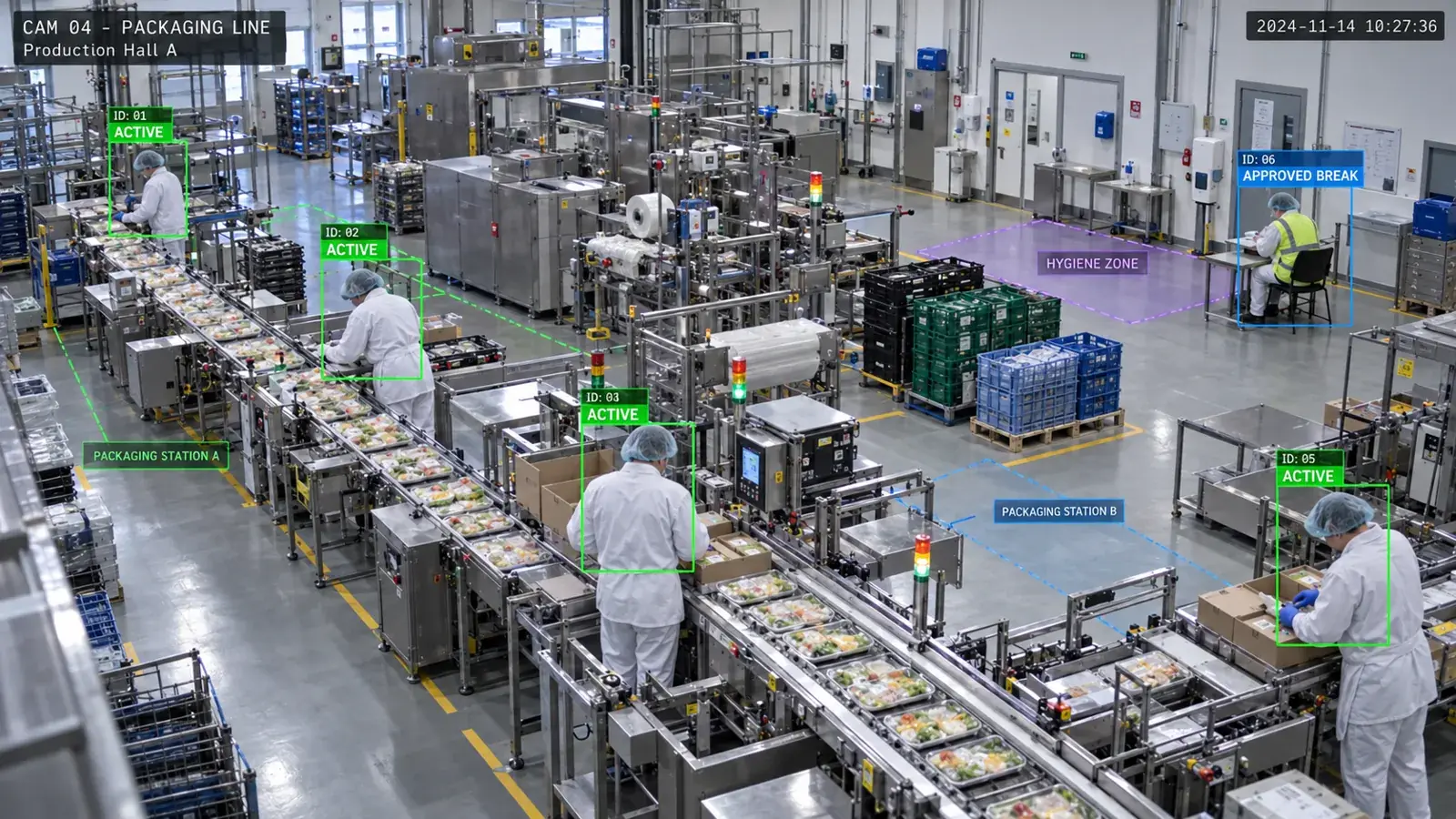
Label inspection on food packaging can be performed quickly and accurately using AI-enhanced camera systems. Hype Vision delivers high-precision, on-site solutions independent of brand or hardware.
The Challenge and Importance of Label Inspection in Food Packaging
Labels on packaging convey essential information such as product details, expiration dates, ingredients, and barcodes. Incorrect, missing, or faulty labels can lead to regulatory violations and damage consumer confidence. Thus, a fast, reliable, and continuous inspection mechanism on the production line is essential.
Failures in proper label inspection may cause costly recalls, reputational damage, or legal penalties. Modern manufacturing facilities mitigate these risks by adopting automation and artificial intelligence technologies.
Traditional Label Inspection Methods and Their Limitations
Traditional label inspection typically involves manual visual checks or simple sensor-based systems. Human inspection is tiring, prone to error, and challenging to maintain consistently.
Sensor-based systems can only detect the presence or absence of labels but cannot verify content accuracy or print quality. These approaches fall short as production speeds increase.
How Label Inspection Works with Cameras and Artificial Intelligence
Image processing systems use IP or CCTV cameras to capture label images on packaging. AI models from the Hype-Model family analyze these images with object detection, classification, OCR (optical character recognition), and position/orientation tracking.
Issues such as incorrect texts, missing labels, wrong barcodes, and color defects are instantly detected. Defective products can be automatically separated from the line, or alerts sent to relevant staff.
- Connect existing cameras brand-independently via RTSP/ONVIF protocols.
- Capture high-resolution images to enhance model accuracy.
- Use OCR to read texts like manufacturing dates and batch numbers and cross-verify with databases.
- Determine label presence and correct positioning through location and orientation tracking.
Camera, Lens, and Lighting Requirements
High-resolution industrial IP cameras are typically used for label inspection. Lens selection depends on label size and camera-to-packaging distance, often favoring fixed-focus or slight zoom lenses.
Lighting is critical to increase contrast and readability of text. LED-based industrial lighting that is stable, shadow-free, and reduces glare is recommended. Color temperature and intensity are adjusted based on packaging materials.
Because package reflectivity and material variability affect AI model accuracy, lighting optimization is essential.
Installation Steps and System Integration
During the pilot phase, production line sections for camera monitoring are identified. Existing IP/CCTV cameras are integrated using RTSP/ONVIF protocols.
Label samples are collected to train appropriate Hype-Model AI models or adapt existing pre-trained ones.
Lighting and optical equipment are installed and camera image quality tested.
Alarm mechanisms can be configured to send WhatsApp/SMS alerts, popup notifications on production screens, PLC outputs, or ERP/MES integration.
The pilot phase typically runs for 2–4 weeks, after which performance is evaluated and permanent solutions deployed.
- Compatibility check of existing IP/CCTV cameras
- Preparation of label samples for AI training
- Lighting and lens configuration
- AI model training and validation
- Alarm and ERP/MES system integration
- Pilot testing and optimization
Applicability Limits of Label Inspection in Food Packaging
The solution operates within a closed network inside the facility, ensuring data security and minimizing risks from internet-connected devices.
AI models may struggle to detect complex print defects, heavily worn, or very low-contrast labels. Critical quality control checkpoints should be complemented with human inspection.
In very high-speed production lines, camera and AI processing performance must be optimized according to product throughput and may require additional hardware.
Differences among ERP/MES and PLC systems during integration may require custom software development.
Label Inspection Pilot with Hype Vision in Food Packaging
Hype Vision, developed at Izleme Vadisi Gebze, is an industrial AI image processing platform that integrates with existing RTSP/ONVIF-enabled camera systems. The Hype-Model family includes modules for object detection, OCR, and position tracking to deliver comprehensive label control.
The pilot typically takes 2–4 weeks, during which the system is tested on the production line, AI models are trained, and lighting and optical settings are optimized. Post-pilot, issues are resolved for full integration.
Real-time error monitoring is supported through alarm and notification modules. REST API integration with ERP, MES, or PLC systems is possible. Most modules comply with data privacy regulations and perform anonymous analysis.
This page answers: food packaging label inspection · automated label inspection food packaging · ai label inspection food packaging · camera based label inspection · food packaging label quality control · label inspection software food industry · food packaging label inspection solution · label inspection systems manufacturers · label inspection cost food packaging · food packaging label inspection implementation
Frequently asked questions
What type of camera is recommended for label inspection on food packaging?
High-resolution industrial IP cameras are preferred. Lens choice depends on label size and distance. Proper industrial lighting is also essential for clear, stable images.
What issues can AI detect during label inspection?
It can identify missing, incorrect, or faulty printing, misaligned labels, unreadable text, and other defects. OCR verifies the accuracy of printed data.
Can existing IP cameras be integrated into the label inspection system?
Yes. Most IP or CCTV cameras supporting RTSP or ONVIF protocols are compatible with the Hype Vision platform.
How is a label inspection system implemented in a facility?
First, the production line is analyzed and cameras integrated. Then AI models are trained and lighting configured. A pilot test is conducted before full deployment.
Why is lighting important for label inspection?
Proper lighting ensures the camera captures clear, glare-free images of printed labels, improving AI model accuracy.
What can AI detect in your factory?
Let's review together which safety, quality and production analytics your existing security cameras can deliver.
- Free 15-minute technical call
- Camera infrastructure pre-assessment
- Feasible AI scenarios