
Forklift and Pedestrian Safety with AI for Powered Industrial TrucksEnhance forklift and pedestrian safety in your warehouse using AI on existing security cameras. On-premise, brand-agnostic, privacy-friendly solution.
Forklift-related accidents remain a critical safety concern in US warehouses and industrial facilities. Powered industrial trucks operating near pedestrians pose risks that require vigilant monitoring and timely alerts.
Hype Vision’s AI-powered solution uses your existing IP or CCTV cameras with RTSP/ONVIF support to provide real-time forklift and pedestrian detection — improving safety with minimal infrastructure changes, on-premise and privacy-conscious.
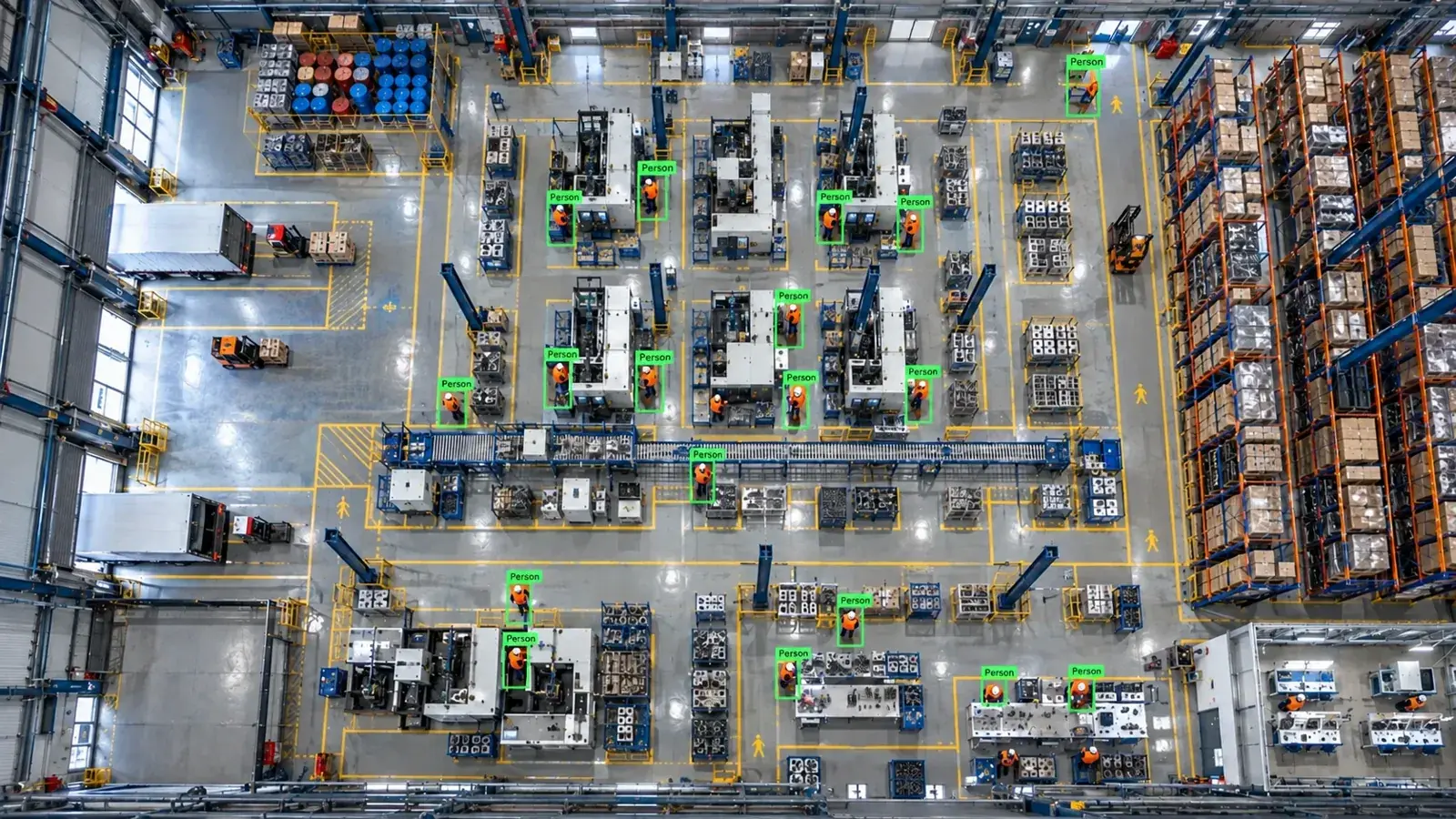
Hype Vision’s AI enhances forklift and pedestrian safety by detecting vehicles and people on your existing security cameras. It runs on-site, respects privacy, and sends real-time alerts to help prevent accidents in warehouses and plants.
The Challenge of Forklift and Pedestrian Safety
Forklifts and other powered industrial trucks (PITs) are essential for material handling but create significant hazards when operating near pedestrians. Collisions can cause serious injury or even fatality.
Facilities must comply with OSHA and ANSI safety practices, such as clear traffic management, proper training, and use of personal protective equipment (PPE). However, human oversight alone is often insufficient to prevent accidents, especially in busy or poorly monitored areas.
Traditional safety measures like physical barriers or signage have limitations. Continuous real-time monitoring and early hazard detection are critical to improving safety outcomes.
How AI on Existing Cameras Improves Safety
Hype Vision’s system leverages the facility’s existing IP or CCTV cameras via RTSP or ONVIF protocols—no brand restrictions—to add AI-powered forklift and pedestrian detection.
The Hype-Model family performs object detection, classification, and tracking directly on-premise, maintaining data privacy by processing video locally without cloud transmission.
When a forklift or pedestrian is detected in a defined zone or moving into a risky proximity, the system generates immediate alerts through dashboards, SMS/WhatsApp, VMS popups, PLC/relay triggers, or external ERP/MES integrations via REST API.
What the AI Detects and Monitors
Key detections relevant for forklift-pedestrian safety include:
It identifies and differentiates between forklifts, other powered industrial trucks, and pedestrians, including pose estimation to recognize movement direction and intent.
The system can monitor zones such as crossing points, blind spots, docking areas, and loading bays where forklift-pedestrian interactions are most hazardous.
- Forklifts and other industrial trucks
- Pedestrians and workers (with privacy-focused anonymization options)
- Movement direction and behavior of both
- Presence in designated safety zones or exclusion areas
Camera Setup and Placement Requirements
Effective AI detection relies on adequate camera positioning and coverage. Cameras should have:
Clear, unobstructed views of aisles, intersections, loading docks, and pedestrian walkways.
Sufficient resolution and lighting to distinguish forklifts and people clearly.
Access to RTSP or ONVIF-compatible video streams for integration with Hype Vision’s software.
While most IP cameras support RTSP/ONVIF, some cloud or closed platforms may restrict stream availability—verification is recommended before deployment.
- Mount cameras to cover critical forklift-pedestrian interaction zones
- Use wide-angle or multiple cameras to reduce blind spots
- Ensure consistent lighting or use cameras with low-light capability
- Verify video stream protocols (RTSP/ONVIF) for compatibility
Limits and Considerations of AI Safety Monitoring
AI detection complements but does not replace safety management protocols, training, or PPE.
Detection accuracy can be affected by severe lighting conditions, camera obstructions, and extreme weather if cameras are outdoors.
Some proprietary camera systems may not provide unrestricted RTSP or ONVIF access, limiting AI integration.
Latency for real-time alerts depends on local computing resources and network setup.
Privacy is prioritized by processing video on-premise without cloud storage of identifiable data.
Getting Started with a Forklift Safety AI Pilot
Initiate a pilot program by selecting 2-4 weeks to assess performance in your environment.
Steps include:
Identify candidate cameras best suited to monitor forklift-pedestrian zones and verify RTSP/ONVIF stream availability.
Deploy Hype Vision software on-premise using edge computing hardware or existing servers.
Configure detection parameters and alert preferences tailored to your operational needs.
Train staff on interpreting alerts and integrating outputs with existing safety workflows or ERP/MES systems.
Evaluate detection accuracy, alert timeliness, and operational impact during the pilot before scaling.
- Select cameras and verify streaming compatibility
- Deploy on-premise AI solution
- Configure detection zones and alerting
- Train personnel on system use
- Monitor for 2-4 weeks and review results
General OSHA and ANSI Guidelines
Hype Vision’s AI safety monitoring supports compliance with OSHA and ANSI best practices by enhancing forklift and pedestrian hazard detection.
However, this content provides general information only and must not be taken as legal advice. Always consult official OSHA/ANSI resources or legal counsel for regulatory compliance.
This page answers: forklift pedestrian safety · forklift pedestrian detection · warehouse forklift safety ai · powered industrial truck safety
Frequently asked questions
What types of cameras work with Hype Vision’s forklift safety AI?
Hype Vision works with most IP and CCTV security cameras that support RTSP or ONVIF streaming protocols. Many common brands are compatible, but it’s important to confirm your cameras provide accessible video streams for integration.
Can this AI system detect both forklifts and pedestrians simultaneously?
Yes, the Hype-Model can identify and track both forklifts and pedestrians concurrently, including their movement and spatial relation, enabling real-time hazard alerts.
Is my video data sent to the cloud for processing?
No, Hype Vision processes video on-premise to protect privacy and minimize latency. Video streams do not leave your facility, and most modules are designed to be privacy-friendly and anonymous.
How do alerts notify my safety team when a forklift-pedestrian hazard occurs?
Alerts can be sent through multiple channels including centralized dashboards, WhatsApp or SMS messages, VMS popups, PLC or relay triggers for onsite alarms, and integration with ERP or MES systems via REST API.
What are common challenges in deploying AI for forklift safety?
Challenges include camera placement to avoid blind spots, ensuring good lighting and image quality, verifying stream compatibility, and integrating alerts effectively into your safety protocols.
How long does a typical pilot take before full deployment?
A standard pilot lasts approximately 2-4 weeks, allowing you to evaluate AI detection accuracy, alert responsiveness, and operational impact before scaling the solution facility-wide.
What can AI detect in your factory?
Let's review together which safety, quality and production analytics your existing security cameras can deliver.
- Free 15-minute technical call
- Camera infrastructure pre-assessment
- Feasible AI scenarios