
AI-Powered Camera System for Restricted Area Entry Detection in WarehousesDiscover how AI-based camera systems detect restricted area entries in warehouses, including camera and lighting needs, installation steps, and Hype Vision solution details.
Security, efficiency, and worker safety are critical in logistics warehouses. Detecting restricted area entries is an effective method to prevent theft, workplace accidents, and production errors.
While traditional controls can be limited, AI-powered camera systems integrated through the RTSP/ONVIF protocol offer faster and more accurate detection.
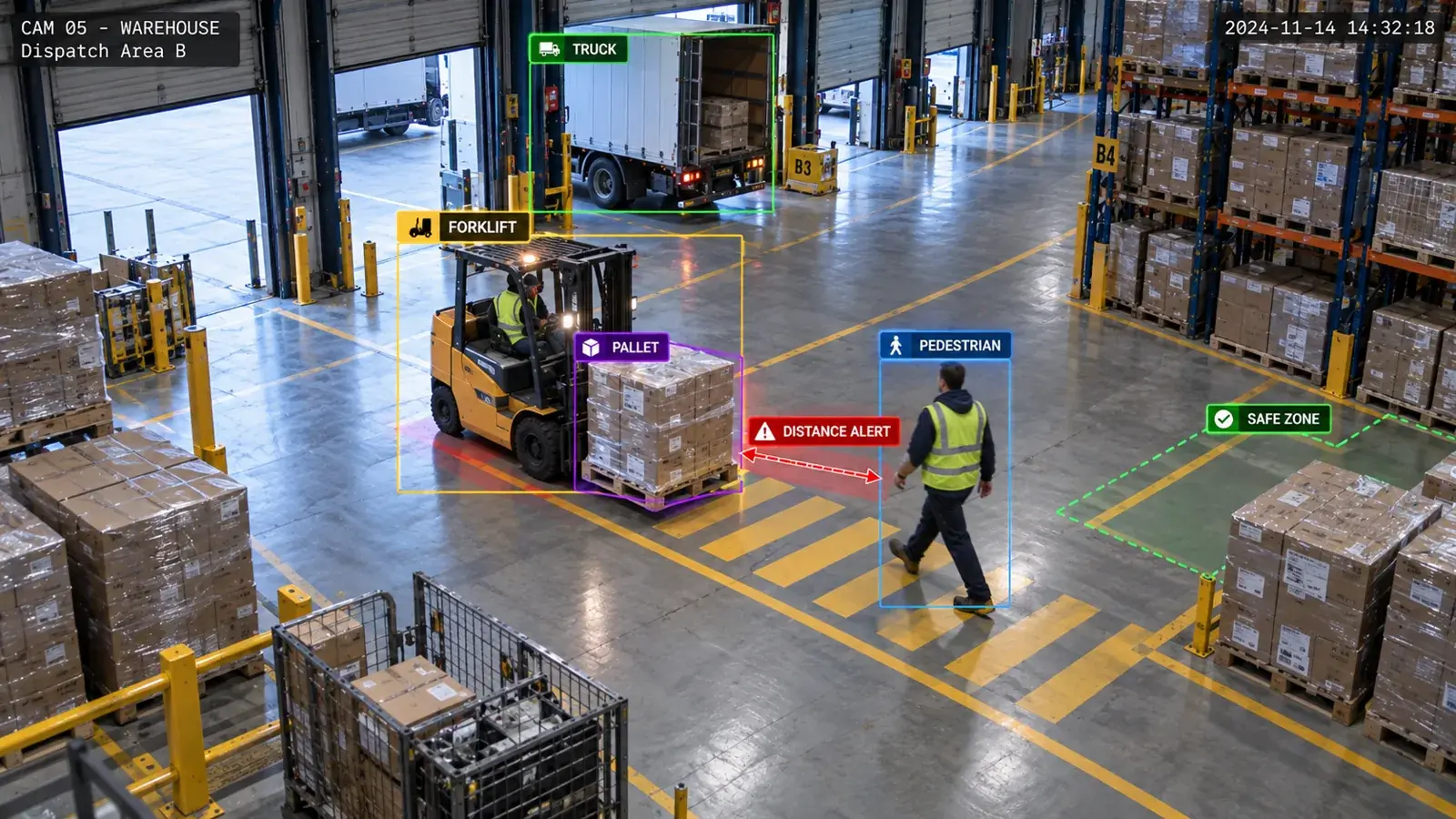
Restricted area entry detection in warehouses is reliably and quickly performed with AI-powered camera analysis. With proper setup and quality hardware, automation is achieved while Hype Vision’s on-premise solution addresses industry-specific needs.
What Is Restricted Area Entry Detection in Warehouses and Why Is It Important?
In logistics warehouses, certain zones are either closed off or access is limited to employees. These restricted areas often contain hazardous machinery, high-value inventory, or zones with elevated operational risks.
Unauthorized entry into restricted areas increases risks of workplace safety violations, data and material losses, while negatively impacting operational efficiency and regulatory compliance. Therefore, effective detection and reporting of such entries is crucial.
- Prevents workplace accidents and enhances employee safety.
- Reduces theft and inventory losses.
- Strengthens control over operational processes.
- Supports regulatory compliance.
Traditional Control Methods and Their Limitations
Traditional methods include physical barriers, manual checks, card access systems, and alarm buttons.
These approaches often fall short due to human error, unpredictable emergencies, and the limitations of manual monitoring.
Additionally, continuous surveillance requires additional personnel and real-time interventions may be delayed.
- Manual monitoring is prone to errors.
- Requires personnel for continuous surveillance.
- Real-time detection and response are challenging.
- Unplanned incidents may go unnoticed.
How Does AI and Camera-Based Restricted Area Entry Detection Work?
Existing IP/CCTV cameras connect via RTSP/ONVIF protocol and utilize the AI-powered Hype-Model family for object detection, classification, and tracking.
Restricted area boundaries are digitally mapped in the system to detect unauthorized employee entries in real time.
Algorithms analyze human movement and posture tracking, triggering alarms only for unauthorized entries to minimize false alerts.
- Camera feeds undergo AI analysis with Hype-Model technology.
- Restricted zones are defined and mapped via software.
- Human presence and movement are detected in real time.
- Alarm mechanisms trigger instantly.
Camera, Lens, and Lighting Requirements
High-resolution IP cameras should be used for accurate detection. Wide-angle or motorized lenses provide optimal area coverage.
Industrial lighting systems, such as LED spotlights or linear lights, ensure sufficient ambient light to prevent loss of quality and detail in low-light conditions.
Camera and lighting selection depend on warehouse size, location of restricted zones, and environmental factors.
- IP cameras with at least Full HD (2MP) resolution are recommended.
- Motorized zoom lenses offer flexible area control.
- Industrial LED lighting is essential in low-light environments.
- RTSP/ONVIF compatible cameras ensure system compatibility.
Installation Steps and Integration Process
First, restricted areas and entry points within the warehouse are mapped.
Existing IP cameras are connected or new cameras and lighting hardware are installed if needed.
Cameras connect through RTSP/ONVIF protocols to the Hype Vision platform and AI models are adapted to the installation environment.
Restricted area boundaries are drawn in the software and alarm scenarios are configured.
The system integrates with ERP/MES, PLC, SMS, WhatsApp, or VMS solutions for real-time notifications and control.
- Identification of restricted areas and entry points.
- Planning camera placement and hardware installation.
- Connecting cameras and applying Hype-Model AI analysis.
- Drawing zones and setting up alarm scenarios in software.
- Integration with related systems and pilot testing.
Applicability Limits and Considerations
AI-based detection systems are limited to the camera’s field of view, making elimination of blind spots critical.
High crowd density or rapid movements can cause misdetections; thus, systems should be customized and calibrated per site.
Lighting variations, external environmental factors, and transparent barriers may affect performance.
Additionally, compliance with personal data protection laws such as KVKK must be rigorously maintained.
- Ensure full coverage of camera fields of view.
- Minimize error rates during high-movement scenarios.
- Stabilize ambient lighting conditions.
- Ensure KVKK compliance for personal data.
Pilot Application of Restricted Area Entry Detection with Hype Vision
Hype Vision’s industrial image processing platform supports brand-agnostic camera connections, AI analysis, and multi-alarm options tailored for the sector.
During a 2-4 week pilot, the warehouse area is analyzed, optimal camera positions identified, and entries monitored in real time with Hype-Model algorithms.
Alarm integrations (WhatsApp, SMS, VMS pop-ups, PLC relays) enable rapid response. As the system operates on-premise, compliance with KVKK and security policies is seamless.
- Brand-independent RTSP/ONVIF camera support.
- Low error rate through Hype-Model AI analysis.
- Multiple alarm and notification channel options.
- KVKK compliance via on-premise deployment.
- Rapid scaling after pilot implementation.
This page answers: warehouse restricted area entry detection · restricted area entry detection system warehouse · AI for warehouse restricted area entry detection · how to detect restricted area entry in warehouse with camera · warehouse restricted area entry detection automation · warehouse restricted area entry detection software · restricted area entry detection solution warehouse · companies providing warehouse restricted area entry detection · cost of warehouse restricted area entry detection · implementation of restricted area entry detection in manufacturing warehouse
Frequently asked questions
How does the warehouse restricted area entry detection software work?
The software applies AI-based Hype-Model analysis to camera feeds connected via RTSP/ONVIF protocols. It monitors human movement and posture to instantly detect and alert unauthorized entry into defined restricted zones.
What camera features are required for restricted area entry detection in warehouses?
At least Full HD resolution IP cameras supporting RTSP/ONVIF protocols should be used. Wide or motorized lenses ensure full area coverage, and industrial LED lighting is necessary for low-light conditions.
What factors influence the cost of restricted area entry detection?
Costs vary depending on warehouse size, number and types of cameras and lighting, integration needs, and custom software adaptations. Hype Vision offers detailed analysis during the pilot phase to provide tailored solutions.
How is the automation of warehouse restricted area detection integrated?
The system integrates with platforms like ERP/MES, PLC, relays, SMS, WhatsApp, or VMS via REST APIs and protocols to enable automatic alarms, recordings, and response processes.
How is restricted area entry detection implemented in manufacturing warehouses?
Hazardous and restricted zones are identified first. Existing camera infrastructure is assessed, then connected to the Hype Vision platform. Restricted zone boundaries are defined in software and analysis begins, followed by comprehensive integration post-pilot.
What can AI detect in your factory?
Let's review together which safety, quality and production analytics your existing security cameras can deliver.
- Free 15-minute technical call
- Camera infrastructure pre-assessment
- Feasible AI scenarios