
Vehicle Wait Time Measurement and Automation Solutions for Loading AreasDiscover how AI-powered camera systems measure vehicle wait times in loading areas, addressing challenges with Hype Vision’s pilot experience.
Vehicle wait time in logistics warehouse loading areas is a key factor affecting operational efficiency. Accurate measurement is essential to reduce delays and optimize resource planning.
Automated analyses powered by cameras and AI surpass traditional methods by providing objective, continuous data.
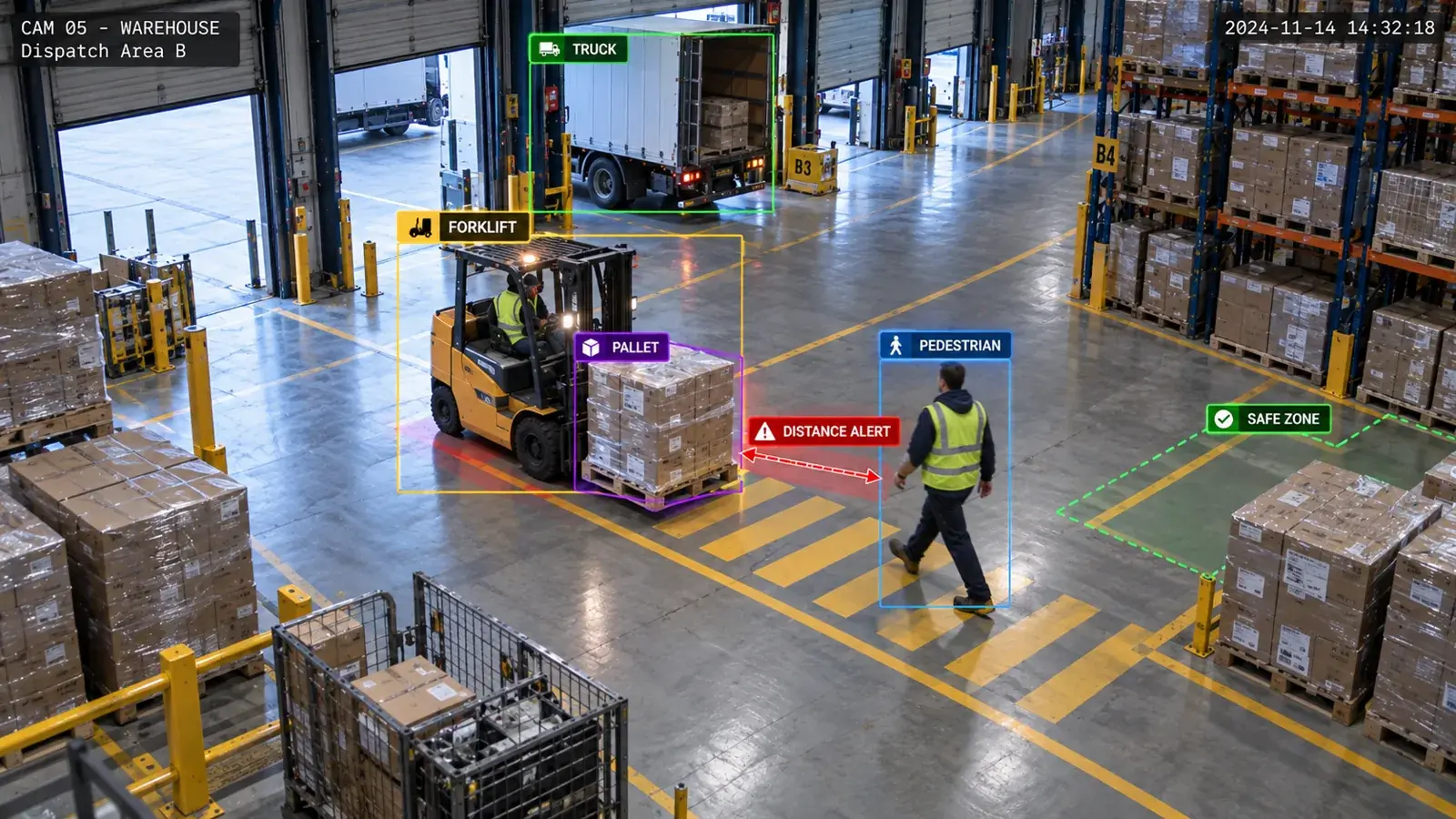
Vehicle wait times in loading areas can be measured automatically and accurately using AI-supported camera systems. This enables more efficient management of logistics operations.
The Challenge and Importance of Measuring Vehicle Wait Time in Loading Areas
In logistics warehouses, the wait times of vehicles at loading areas directly impact transportation and business process efficiency. Prolonged waiting leads to labor inefficiencies, time loss, and increased costs.
Measuring wait times offers critical feedback for warehouse management and helps identify operational bottlenecks.
Limitations of Traditional Wait Time Monitoring Methods
Manual records, timestamp logs, and employee observations are prone to errors and insufficient for continuous monitoring.
Manually collected data often suffer from accuracy and bias issues, with limited ability for real-time integration and analysis.
How Are Vehicle Wait Times Measured Using Cameras and Artificial Intelligence?
Industrial IP/CCTV cameras integrate into existing systems via RTSP or ONVIF protocols. Hype Vision’s proprietary AI models (Hype-Model family) perform vehicle detection, pose tracking, and anonymous density analysis.
Vehicle entry and exit times at loading zones are automatically detected to calculate wait durations, all while maintaining GDPR-compliant data privacy without recording identity information.
Camera, Lens, and Lighting Requirements
Appropriate industrial cameras should be selected to ensure clear and consistent image quality.
Lens choice depends on area size, mounting height, and viewing angle; wide-angle lenses may be unsuitable for narrow spaces or where obstructions exist.
Inadequate natural lighting should be supplemented with industrial illumination. Hype Vision systems can also utilize specialized camera and lighting combinations for quality control.
Installation Steps and System Integration
1. Analyze existing IP/CCTV camera infrastructure and identify optimal locations.
2. Integrate cameras with the Hype Vision platform via RTSP/ONVIF connections.
3. Configure AI modules for the target zones (vehicle detection, wait time measurement).
4. Install additional cameras, lenses, and lighting hardware if needed.
5. Set up alarm and reporting systems (dashboard, WhatsApp/SMS alerts, VMS pop-ups, PLC, ERP/MES integration).
6. Conduct a 2–4 week pilot period to evaluate performance and implement improvements.
Applicability Limits and Considerations
Results may be affected by camera viewing angles, environmental conditions such as dust or rain, and variations in vehicle types.
Real-time health monitoring and module updates help continuously improve system performance.
Since Hype Vision modules operate on anonymized data, risks related to permissions and data privacy are minimized.
Hype Vision’s Pilot Experience for Vehicle Wait Time Measurement in Loading Areas
Developed at Bilişim Vadisi Gebze, Hype Vision’s AI-supported platform offers tailored solutions through 2–4 week pilot projects.
During pilots, the client’s existing camera infrastructure is utilized to analyze and report on the loading area, identifying operational inefficiencies and cost-saving opportunities.
At pilot completion, system compatibility, performance, and integration options are thoroughly evaluated to prepare for full-scale deployment.
This page answers: vehicle wait time measurement loading area · loading area vehicle wait time system · ai for vehicle wait time measurement loading area · how to measure vehicle wait time with cameras loading area · loading area vehicle wait time automation · wait time measurement software for loading areas · vehicle wait time measurement solution · companies providing vehicle wait time measurement · cost of vehicle wait time measurement · implementation of vehicle wait time measurement in production facilities
Frequently asked questions
Which types of cameras are suitable for measuring vehicle wait times in loading areas?
Industrial IP/CCTV cameras that support RTSP/ONVIF protocols and can be easily connected to the Hype Vision platform are recommended. Clear imaging and stable viewing angles are crucial.
How does the AI camera system measure wait times?
The system detects vehicles using AI, records their entry and exit times, and automatically calculates wait durations without human intervention.
What is the typical installation timeframe and process?
A standard pilot implementation lasts 2–4 weeks. It includes infrastructure analysis, camera integration, AI module configuration, and testing phases.
Do lighting and environmental conditions affect system performance?
Yes, low lighting, dust, or fog can impact image quality. In such cases, specialized lighting or optimized camera placement is advised.
Is the Hype Vision solution GDPR compliant?
Yes, the system operates on anonymized data without processing personal information, ensuring strong compliance with GDPR.
What can AI detect in your factory?
Let's review together which safety, quality and production analytics your existing security cameras can deliver.
- Free 15-minute technical call
- Camera infrastructure pre-assessment
- Feasible AI scenarios