
Warehouse Safety AI Using Existing Security CamerasImprove warehouse safety with AI video analytics that work on your existing cameras via RTSP and ONVIF protocols. Start a quick on-premise pilot today.
Warehouse facilities face constant challenges maintaining safety for personnel and equipment. Leveraging AI-powered video analytics on existing IP or CCTV security cameras enables proactive safety monitoring without costly camera upgrades.
Hype Vision’s warehouse safety AI works with your current cameras using standard RTSP/ONVIF streams, running on-premise for privacy and data control. This solution helps detect hazards, unsafe behaviors, and ensure compliance with PPE and forklift safety protocols.
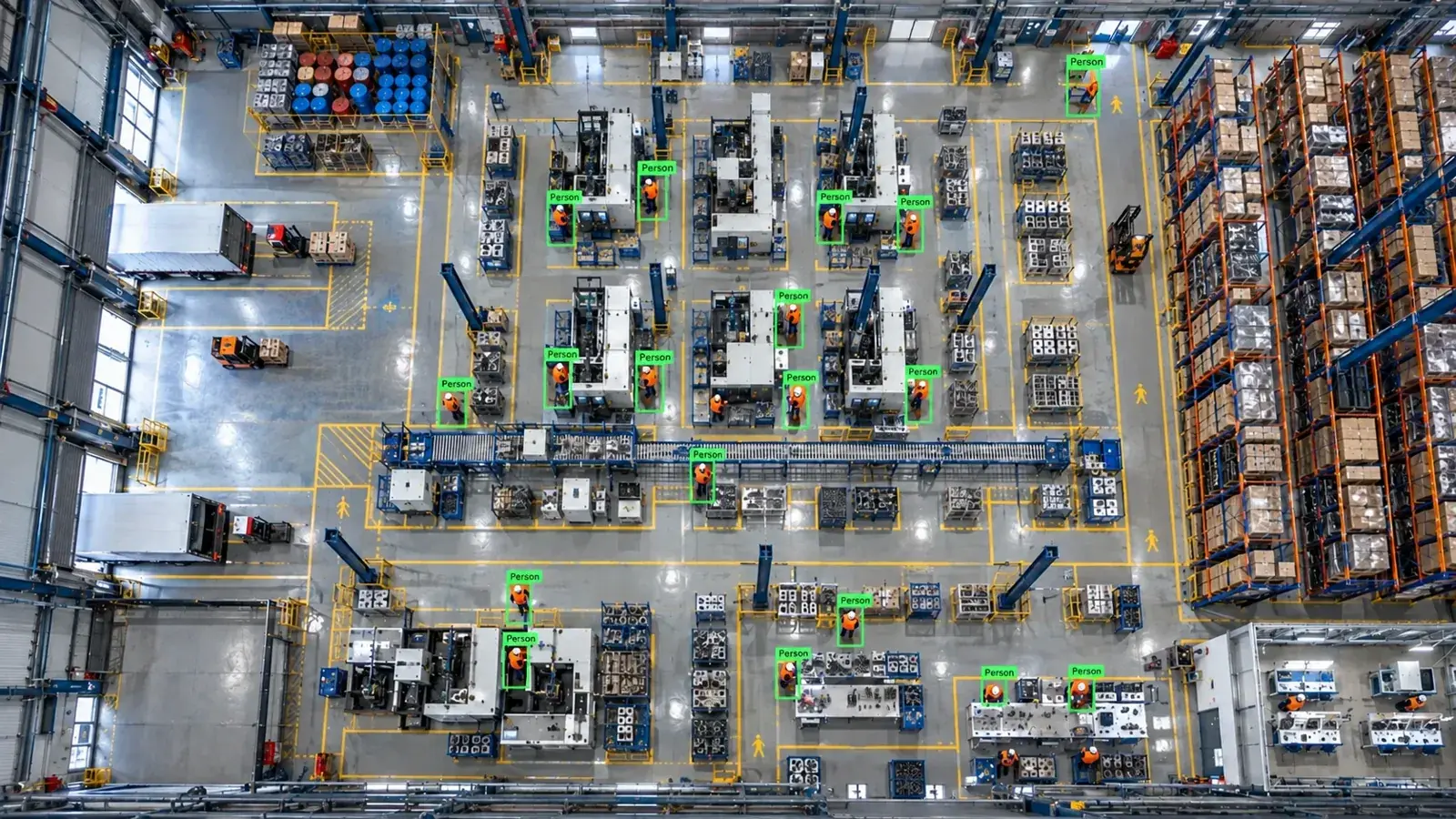
Warehouse safety AI applies intelligent video analytics to your existing security cameras, detecting workplace hazards and unsafe behaviors on-site. It connects easily via RTSP/ONVIF, runs on-premise, and starts with a 2-4 week pilot for quick results.
The Warehouse Safety Challenge
Warehouses and distribution centers have complex safety risks involving forklifts, pallet jacks, and pedestrian workers, where slips, falls, collisions, and PPE non-compliance can cause serious incidents. Traditional safety measures rely heavily on manual observation, audits, and incident reporting, which are often after the fact or difficult to scale across large facilities.
Automated video analytics can provide continuous, real-time safety monitoring, helping reduce risks and improve compliance across the workplace.
Applying AI to Existing Security Cameras
Instead of installing costly new cameras or sensors, Hype Vision’s warehouse safety AI integrates with your existing IP/CCTV cameras that support RTSP or ONVIF streaming standards. This brand-agnostic approach leverages the current camera infrastructure, minimizing deployment time and expense.
All AI processing runs locally on-premise at your facility, ensuring privacy and avoiding cloud dependencies or bandwidth concerns. The Hype-Model family of algorithms includes object detection, classification, pose estimation, and OCR to identify various safety-related events.
- Works with nearly any camera brand supporting RTSP and/or ONVIF
- No cloud connection needed; data stays on-site for privacy
- Supports integration with security dashboards, VMS popups, SMS/WhatsApp alerts, PLC/relay triggers, and ERP/MES systems via REST API
Key Warehouse Safety Use Cases and Detection Features
Hype Vision AI detects and classifies objects and incidents critical to warehouse safety, such as:
This AI greatly assists EHS and operations teams by providing timely alerts and visual evidence to intervene before accidents escalate.
- PPE compliance: Helmet, vest, gloves detection to ensure worker PPE use
- Forklift and pedestrian interaction: Safe distances, collision warnings
- Unsafe postures and falls: Identifying workers in potentially dangerous positions
- Hazard zones and restricted areas: Monitoring unauthorized entries
- Load handling: Overhead lifting, stacking errors
- Safety sign and label recognition via OCR
Camera and Placement Requirements for Effective AI
Optimal AI performance depends on camera placement, field of view, resolution, and angle. Existing security cameras typically meet basic needs if positioned to cover key work areas with minimal obstructions.
Best practices include:
Limitations include challenges with very low resolution, heavy occlusion, or cameras with restricted streaming options from some cloud/closed platform providers.
- Use cameras covering forklift routes, loading docks, and pedestrian zones
- Ensure stable RTSP/ONVIF streaming access from camera or VMS
- Prefer higher resolution (720p or above) for better object classification
- Adjust angles to avoid restricted views or excessive glare
- Avoid heavy footage compression or encryption blocking continuous stream access
Limitations and Feasibility Considerations
While AI video analytics greatly enhance warehouse safety, they are not a standalone solution. They support but do not replace human safety oversight or comprehensive training programs.
Certain scenarios may reduce detection accuracy, such as extreme low-light, crowded views, or highly reflective surfaces. Some proprietary camera cloud services limit access to RTSP/ONVIF streams, which can impede integration.
The AI modules are designed to be privacy-friendly with anonymized data processing, which is critical for compliance and employee acceptance.
Getting Started: Pilot Deployment in 2-4 Weeks
A typical rollout begins with a short pilot program of 2 to 4 weeks to validate AI performance and integration for your facility.
The pilot steps include:
This phase allows your EHS and operations teams to evaluate alerts, dashboard usability, and system integration before committing to full-scale deployment.
- Initial consultation to select monitoring areas and cameras
- Installation and configuration of Hype Vision edge hardware/software on-premise
- Connecting to existing cameras over RTSP/ONVIF
- Fine-tuning the Hype-Model AI to detect relevant objects and events
- Testing alert delivery via dashboard, SMS/WhatsApp, and VMS popups
- Review pilot results with safety and operations management
General Safety and Compliance Notes
Hype Vision video analytics complements workplace safety programs aligned to general OSHA and ANSI standards related to warehouse operations and PPE compliance. However, this page provides general information and should not be considered legal advice. Consult safety professionals and regulatory agencies for specific compliance requirements.
This page answers: warehouse safety ai · warehouse ai video analytics · warehouse ppe forklift safety · distribution center safety ai
Frequently asked questions
Can Hype Vision AI work with my existing warehouse cameras?
If your cameras support RTSP or ONVIF streaming, Hype Vision AI can connect and process their video feeds without needing new equipment. Some cloud or proprietary platforms may restrict access to needed streaming protocols.
What types of warehouse safety incidents can the AI detect?
The AI detects PPE compliance, forklift and pedestrian proximity, unsafe postures, hazard zone breaches, load handling issues, and can even read safety signs using OCR to enhance situational awareness.
Does the AI require sending video to the cloud?
No, Hype Vision’s solution runs fully on-premise, keeping all video processing local to protect privacy and avoid reliance on internet bandwidth.
How long does it take to start a pilot?
Typically 2 to 4 weeks for pilot setup, including initial consultation, installation, camera integration, and tuning the AI models for your warehouse environment.
Are there privacy concerns with using AI on security cameras?
Hype Vision prioritizes privacy by processing anonymously on-premise without storing personally identifiable information, aligning with privacy-friendly safety monitoring practices.
Will the AI replace safety personnel?
No, AI video analytics augment human safety programs by continuously monitoring and alerting, but do not replace trained safety professionals or comprehensive safety protocols.
What can AI detect in your factory?
Let's review together which safety, quality and production analytics your existing security cameras can deliver.
- Free 15-minute technical call
- Camera infrastructure pre-assessment
- Feasible AI scenarios